



Peptide Bioregulators by Organ System: A Research Overview
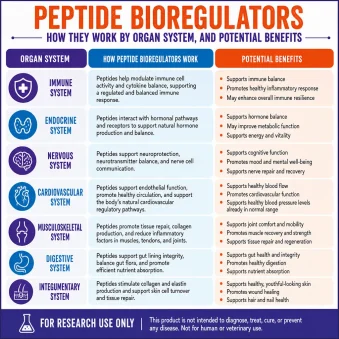
Peptide bioregulators are a family of very short synthetic peptides, most of them two to four amino acids, each tied to a specific organ. They came out of one Soviet-era research program and they remain an odd corner of peptide science: a large catalog, a bold mechanistic claim, and a thin independent evidence base. This research-use-only overview maps which compound goes with which tissue and says plainly what the research does and does not support.
Research-use-only disclaimer: The bioregulator compounds discussed here are intended strictly for in-vitro and laboratory research use and are not intended for human or veterinary use in that context. Every finding below is drawn from cell-culture or animal reports and is described in hedged terms. Nothing here is medical advice or a treatment claim for any organ or condition.

TL;DR
Peptide bioregulators are short synthetic peptides (mostly 2 to 4 residues) developed by Vladimir Khavinson's group, each derived from an extract of one organ and studied in connection with that tissue. Prostate goes with Prostamax, lung with Chonluten, thymus with Vilon and Thymogen, liver and gut with Livagen and Ovagen, pancreas with Pancragen, heart with Cardiogen, testes with Testagen. The proposed mechanism is direct peptide interaction with DNA. Evidence is mostly Russian-language and not independently replicated. Research use only.
What they are: short synthetic peptides, mostly 2 to 4 amino acids, one per organ system.
Where they came from: Khavinson's group, St. Petersburg Institute of Bioregulation and Gerontology, from organ-extract preparations.
Proposed mechanism: peptide entry into the nucleus and interaction with DNA, influencing transcription.
Evidence: largely Russian-language, decades old, one research lineage, no large controlled human trials.
What Are Peptide Bioregulators?
Bioregulators are short synthetic peptides developed from extracts of specific animal organs. The research program began in the Soviet Union in the 1970s under Vladimir Khavinson, initially working with organ extracts (the preparations later called cytomedines), then isolating short sequences the group proposed carried the activity. The result is a catalog where each compound is paired with one tissue.
The compounds are unusually small. Vilon is two residues. Epitalon is four. For comparison, insulin is 51. That size difference is the whole reason the mechanism question is interesting, and the reason plenty of biochemists are skeptical.
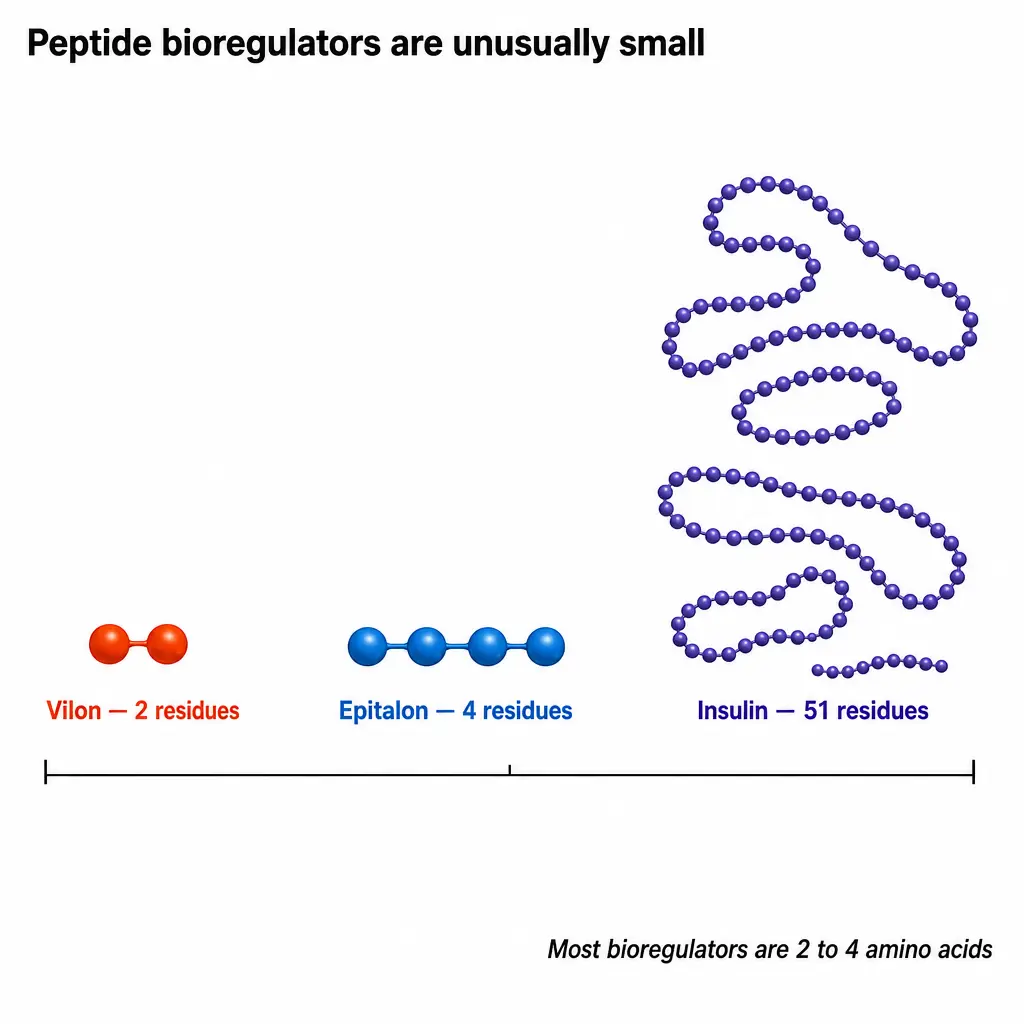 A scale-comparison infographic on a white background, 16:9. Three molecules are drawn side by side on a common horizontal baseline, each as a chain of connected amino-acid beads, sized to true relative scale." width="820" height="430" loading="eager" decoding="async" itemprop="image">
Which Bioregulator Goes With Which Organ?
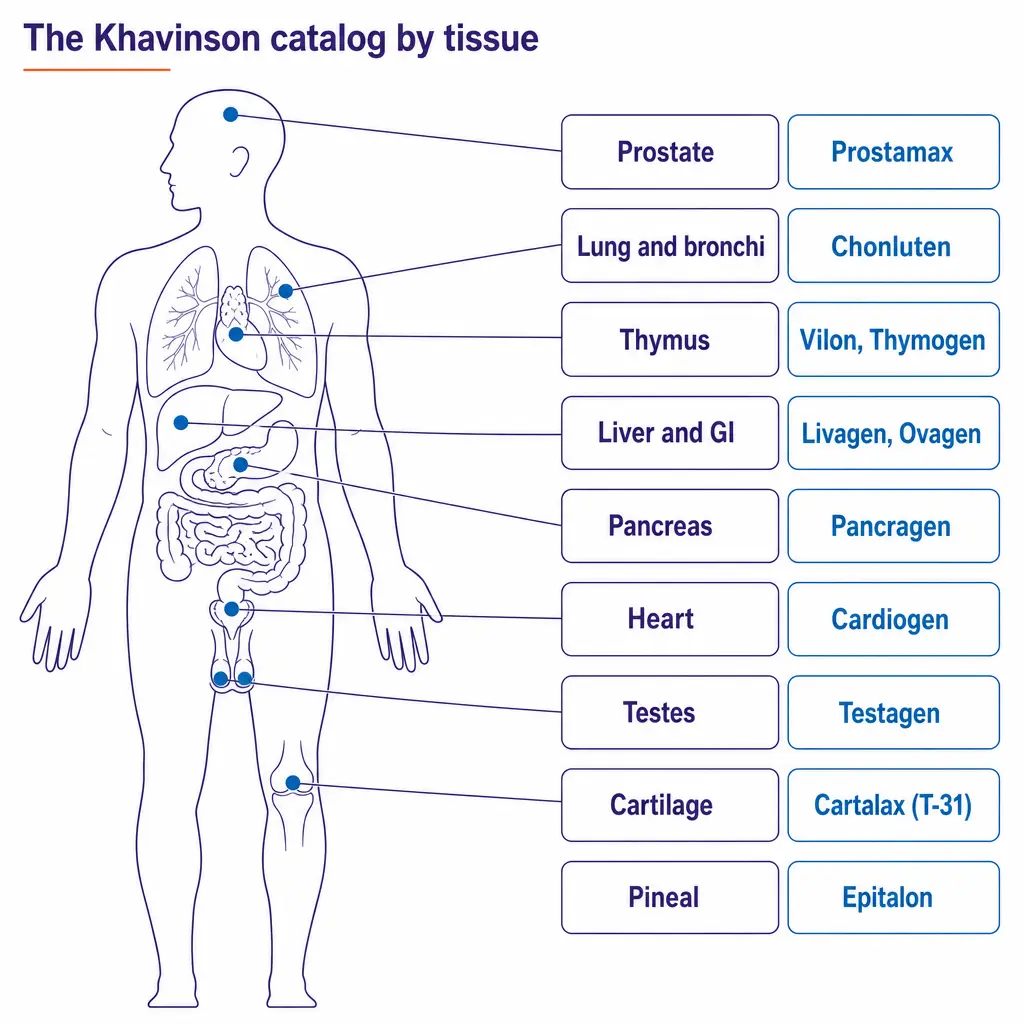
| Organ system | Bioregulator | Studied in connection with |
|---|---|---|
| Prostate | Prostamax | Prostate tissue and cell function |
| Lung and bronchi | Chonluten | Bronchial mucosa, respiratory tissue |
| Thymus | Vilon (Lys-Glu), Thymogen (Glu-Trp) | Immune and thymic cell populations |
| Liver and GI tract | Livagen, Ovagen | Hepatic and gastrointestinal tissue |
| Pancreas | Pancragen | Pancreatic cell function |
| Heart | Cardiogen | Cardiac and vascular tissue |
| Testes | Testagen | Testicular tissue |
| Cartilage | Cartalax (T-31) | Cartilage, cellular aging |
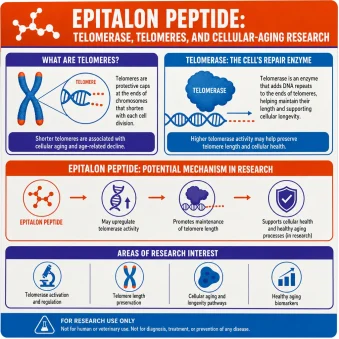
| Pineal | Epitalon | Telomerase, cellular aging |
The pattern is tidy enough that it is worth naming the obvious objection: a catalog with one peptide per organ looks more like an organizing scheme than a discovery. Whether each compound genuinely has tissue-selective activity is exactly the question the independent literature has not answered.
How Are Bioregulators Thought to Work?
The proposal is that peptides this short can pass into the cell and into the nucleus, then interact with DNA or chromatin and influence which genes are transcribed.[1] Under that model a bioregulator is not a signal binding a receptor on the cell surface; it is closer to a small molecule sitting on the genome and changing what gets read.
The Khavinson group supports this with their own binding studies and gene-expression work. It has not been picked up and confirmed broadly by independent structural biology, and I am not aware of a well-replicated crystal or high-resolution structure showing tissue-selective DNA binding for these dipeptides. So: a coherent hypothesis from its originators, not settled mechanism.
 A four-stage cell-biology process diagram, 16:9, white background, read left to right. Stage 1: a short two-bead peptide in #e44d14 approaching a cell. Stage 2: the peptide crossing a #0274be plasma membrane drawn as a clean phospholipid bilayer. Stage 3: the peptide crossing a #3a2e8f nuclear envelope into the nucleus. Stage 4: the peptide sitting in the minor groove of a #0274be DNA double helix, with a small gene segment downstream switching from grey to #0274be to indicate transcription. Thin #3a2e8f arrows connect the stages." width="820" height="430" loading="eager" decoding="async" itemprop="image">
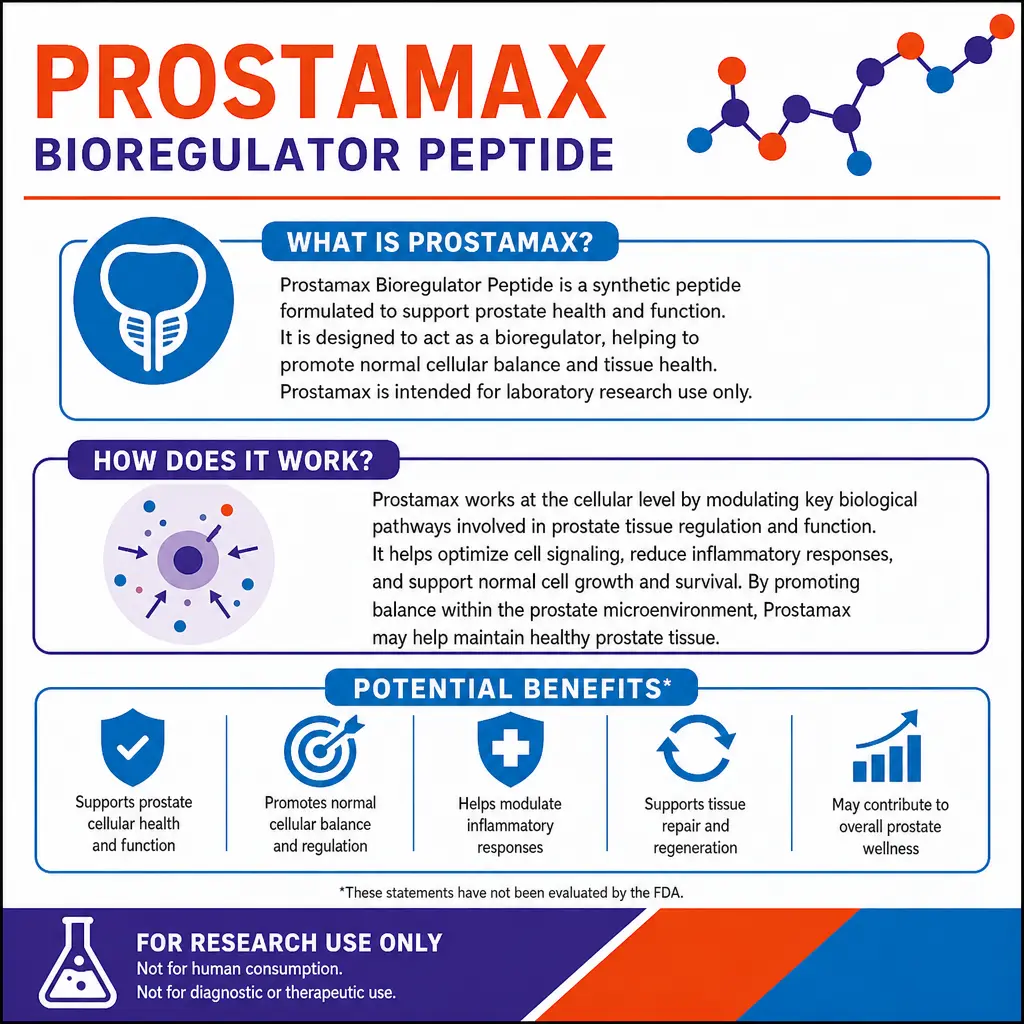
Prostate Bioregulator Research (Prostamax)
Prostamax is the prostate entry, and it is the most searched of the set. It descends from the prostate peptide preparations that also produced the clinically used Russian products in that family, which is part of why it carries more name recognition than its siblings. Reported research covers prostate cell function and tissue-specific activity in animal models.
Because prostate health is a consumer-heavy search area, this is the compound where the gap between what the research says and what the internet says is widest. The research reports cell and animal observations. It does not establish treatment effects, and anything you read framing Prostamax as a therapy for prostate conditions has left the evidence behind.
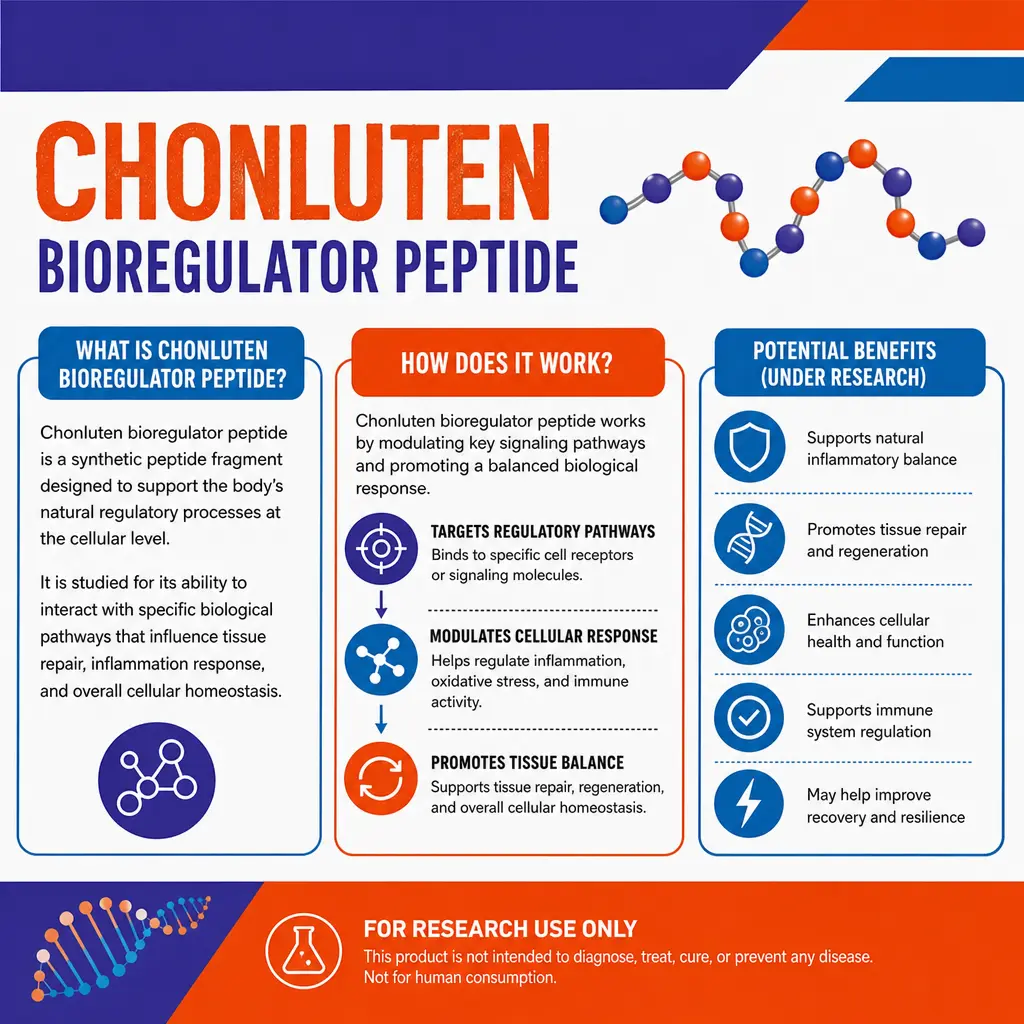
Lung Bioregulator Research (Chonluten)
Chonluten is associated with lung and bronchial mucosa. Reported work looks at respiratory tissue in animal models. There is less of it than for the thymus or pineal compounds, and I would treat the lung bioregulator literature as the thinnest of the well-known entries.
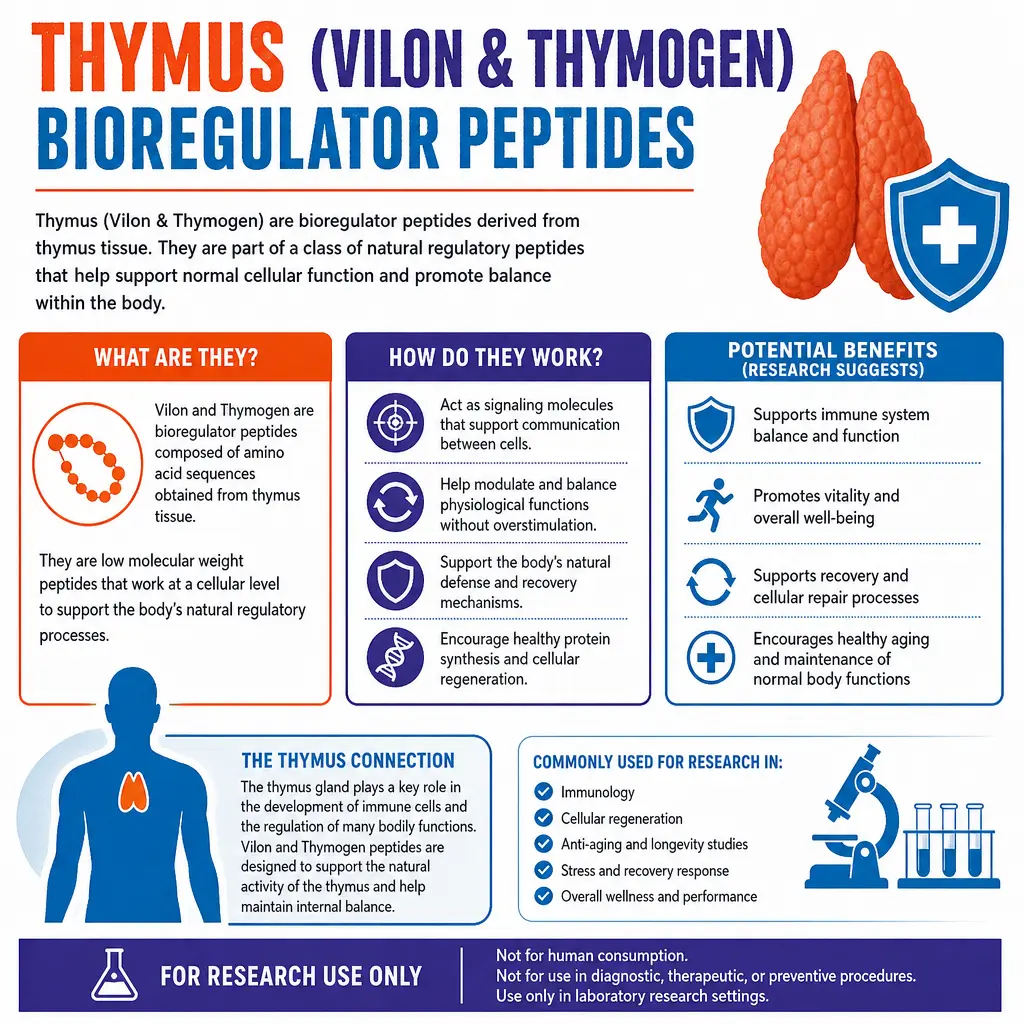
Thymus Bioregulator Research (Vilon, Thymogen)
The thymus has two entries, Vilon (Lys-Glu) and Thymogen (Glu-Trp). This is the best-developed corner of the catalog, probably because thymic involution with age gave the gerontology-focused group a clear question to work on. Reported findings center on immune cell populations and gene expression.
Two different dipeptides tied to the same organ is also the closest thing this family offers to an internal control. If both produce the same effects, that is informative. If they diverge, that is more informative still.
Liver, Pancreas, Heart, and Testes
Livagen and Ovagen cover liver and gastrointestinal tissue, and Ovagen is the compound where PrymaLab has seen the clearest independent pickup. Pancragen is the pancreas entry, Cardiogen the heart, Testagen the testes. Reported research for each follows the same shape: tissue-associated activity in animal or cell models, published largely within the originating research lineage.
Researchers frequently compare Ovagen and Livagen directly, since both sit in the hepatic and gastrointestinal group.
How Good Is the Evidence?
Weak, and specifically weak in a way researchers should understand before building around it. The bulk of the bioregulator literature is Russian-language, dates from the 1980s through the 2000s, and comes from a small set of connected groups centered on one institute. Large controlled human trials do not exist for these compounds. The central mechanistic claim, that dipeptides regulate transcription by direct DNA interaction, has not been independently confirmed at the structural level.
None of that makes the compounds uninteresting. Short peptides are cheap, chemically simple, and easy to characterize, which makes them decent tools for asking whether minimal sequences can produce measurable cellular effects. It does mean that any page presenting bioregulators as established organ therapies is selling you something. Epitalon is the partial exception: its telomerase result has at least one independent replication, described in the Epitalon reference.
How is research-grade bioregulator material characterized?
These are short peptides, so identity and purity confirmation is straightforward and worth insisting on, since the compounds themselves are inexpensive and the literature is imprecise enough that you want to be certain what is in the vial. Research-grade material is typically verified by reversed-phase HPLC for purity and mass spectrometry for identity, handled cold, and supplied for laboratory use only. At PrymaLab, research peptides are characterized with HPLC/MS verification and independent third-party testing. No specific lot data are asserted in this general reference.
Frequently Asked Questions
What are peptide bioregulators?
Very short synthetic peptides, usually two to four amino acids, developed by Khavinson's group from organ extracts, each studied in connection with one tissue. Research use only.
Which bioregulator is for the prostate?
Prostamax is the prostate-associated entry in the catalog. It is studied in prostate cell and animal models, and it is not a treatment for any prostate condition.
Which bioregulator is for the lungs?
Chonluten, associated with lung and bronchial mucosa.
Do peptide bioregulators actually work?
The published reports describe effects in cell and animal models. Independent replication is limited, the literature is largely Russian-language, and controlled human trials are absent. Treat the compounds as research tools with an unresolved evidence base.
References
- Khavinson VK. Peptides and ageing. Neuro Endocrinol Lett. 2002;23(Suppl 3):11–144.
- Khavinson VK, Malinin VV. Gerontological aspects of genome peptide regulation. (Monograph.)
- Overview of Epitalon: a highly bioactive pineal tetrapeptide (review). PubMed. 2025. PMID:40141333
Final disclaimer: This article is an educational research reference. Peptide bioregulators are sold and studied for laboratory research use only and are not approved by any regulatory authority for human or veterinary use. Statements have not been evaluated by the FDA. Nothing here should be interpreted as medical advice or as a treatment claim for the prostate, lungs, heart, liver, pancreas, testes, or any other organ.
The bioregulator evidence base is limited, largely Russian-language, and not independently replicated at scale. Always verify the legal status of any research compound in your jurisdiction before purchase or use.